OpenTelemetry without the chaos
Cut observability costs, test every change before it ships, route telemetry anywhere, and manage your whole fleet with Telflo.
Use cases
Take control of your telemetry pipeline
Cut the bill, ship changes without breaking prod, and keep regulated data where it belongs. Here is what teams use Telflo for.
Architecture
Your collectors, your data. Telflo's control plane.
Your telemetry flows the same way it always has, from your services through your collectors to your backends. Telflo just gives you an easy way to run the configuration that produces it.
Telflo doesn't have a backend of its own. Your collectors export straight to whichever backends you pick, and you can route to several at once or switch any time.
Lifecycle
How it works
Write a config, validate it, test it against sample data, and roll it out to your fleet. Here is each step as it looks in Telflo.
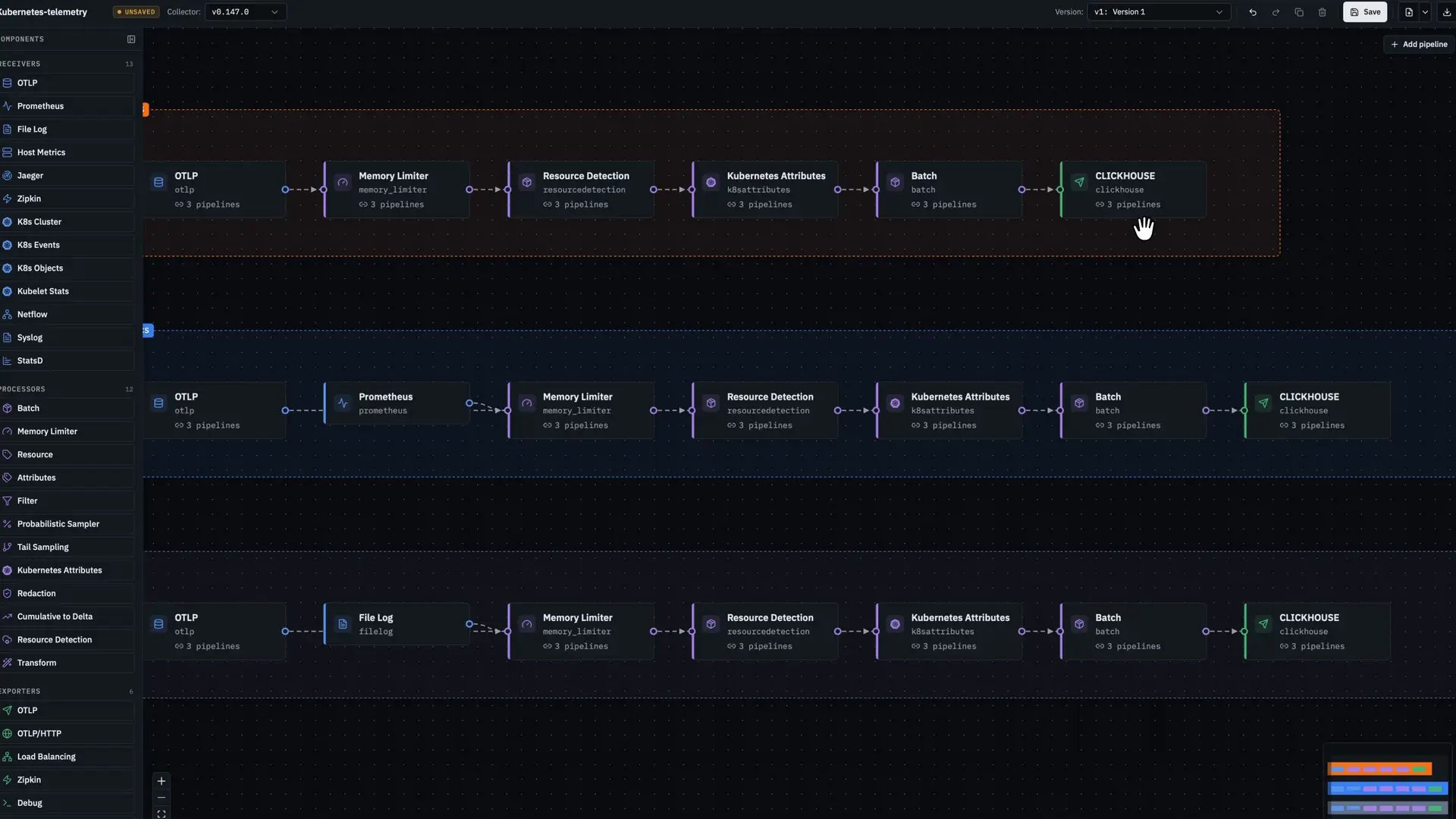
Build
Build or import your collector configs.
Drag receivers, processors, and exporters onto the canvas, or bring in a config you already run. Paste the YAML, or point an existing collector at Telflo to import what it reports.
Visualize
See the whole pipeline at a glance.
Receivers, processors, exporters in three colors. Trace any signal from source to backend without scrolling YAML.
Validate
Catch errors before they ship.
It validates against the real OTel schema and type-checks every reference. Broken configs never leave the editor.
Test
Unit tests, but for telemetry pipelines.
Write rules for your processors, then run a change against sample or uploaded telemetry on the real collector. The rules assert on the output, so broken transformations never reach production.
Deploy
One push to every collector.
Native OpAMP fleet management. No SSH loops, no config drift, no manual restarts. Stage a version on a few collectors, promote it fleet-wide, and roll back instantly when something breaks.
Govern
ComingGolden paths for telemetry config.
Platform teams decide which processors, exporters, and policies are allowed. App teams build pipelines from those pre-vetted components, and OPA enforces the rules so nothing ships out of compliance.
Features
Built for the way OTel actually works
Upstream OpenTelemetry with a control plane around it. No middleware or proprietary agent in between.
Build or import it
Drag components onto the canvas, or write the YAML by hand. Both stay in sync, so you can work whichever way you prefer.
AI assistance
Describe what you want in words, not YAML, and the agent builds it against your real config. Then it checks its own work, looping on schema errors until the config is valid. Nothing broken reaches you.
OpAMP-native fleet
Push validated configs to remote collectors over OpAMP. Run the supervisor on hosts and VMs, or Bridge Fleet on Kubernetes, where it works the way clusters already do.
Testing
Run a change against sample or uploaded telemetry on the real collector, and check the processed output is what you expect.
Validation
It validates against the real OTel schema and type-checks references. Broken configs never leave the editor.
Rollbacks
Something breaks? Restore the previous config across the fleet in one click.
Staged rollouts
Pin a new version to a few collectors first, confirm they are healthy, then promote it to the whole fleet.
Versioning
Every change is versioned and audited, so every fleet keeps a full config history.
Flows
Start from a pipeline that already works
Prebuilt collector configurations, each solving one problem. Researched against the component docs, validated with the real collector binary, and ready to open in the editor.
For observability backends
If your platform ingests OpenTelemetry data, Telflo helps your customers build, test, and roll out the collector pipelines that route their data to you.
Get started
Ready to run a real control plane?
Start building your first OpenTelemetry pipeline in the editor. No install, no credit card. Bring the collector config you already run.